The Ultimate Guide to Sports Bet Tracking: Why Every Serious Bettor Needs a Journal
Introduction: The Hidden Secret of Profitable Bettors
Here's a truth that separates winning bettors from the masses: they track every single wager.
While recreational bettors place bets based on gut feelings and hunches, professional and serious bettors maintain detailed records of every pick, stake, and outcome. This isn't obsessive behavior—it's the foundation of long-term profitability in sports betting.
If you're not tracking your bets, you're essentially flying blind. You might think you're profitable, but without data, you're just guessing. And in a game where the house has a built-in advantage, guessing isn't a winning strategy.
This comprehensive guide will show you exactly why sports bet tracking matters, what metrics you need to monitor, and how to build a tracking system that turns raw data into actionable insights. Whether you're a weekend warrior or aspiring professional, this guide will transform how you approach sports betting.
Why Sports Bet Tracking Is Non-Negotiable for Success
The Data Tells the Truth
Your memory is unreliable. After a winning streak, you feel invincible. After a losing run, you feel cursed. Neither feeling reflects reality.
A proper sports bet tracker cuts through emotion and shows you the cold, hard facts:
Your actual win rate (not what you think it is)
Which sports you're profitable in
Which bet types cost you money
Whether you're getting closing line value
Your true return on investment
Real Example: Mike, a college football bettor, swore he was "great at picking underdogs." When he finally started tracking, he discovered he was losing 18% on underdog bets but winning 12% on favorites. His "strength" was actually his biggest weakness.
Identify Your Edge (Or Lack Thereof)
Every successful bettor has an edge—a specific area where they outperform the market. Without tracking, you'll never find yours.
Common edges that tracking reveals:
Sport-specific advantages: Maybe you crush NHL but struggle with NBA
Bet type specialization: Perhaps you're elite at player props but terrible at totals
Timing edges: You might profit by betting early lines but lose on closing action
Market inefficiencies: Small conferences, less popular sports, or specific leagues
Bankroll Protection Through Awareness
Tracking creates accountability. When you see your losses in black and white, you're less likely to:
Chase losses with bigger bets
Bet outside your bankroll limits
Make emotional wagers after bad beats
Ignore proper stake sizing
The Numbers Don't Lie: Studies of bettor behavior show that those who track their wagers experience 40% fewer instances of tilt-induced betting and maintain bankrolls 3x longer than non-trackers.
What Is a Sports Bet Tracker?
A sports bet tracker is any system that records, organizes, and analyzes your betting activity. At its core, it's a tool for transforming raw bet data into meaningful insights about your performance.
Types of Bet Tracking Systems
1. Manual Spreadsheets
Excel or Google Sheets templates where you manually enter each bet's details. These offer complete customization but require significant time and Excel knowledge.
2. Dedicated Bet Tracking Apps
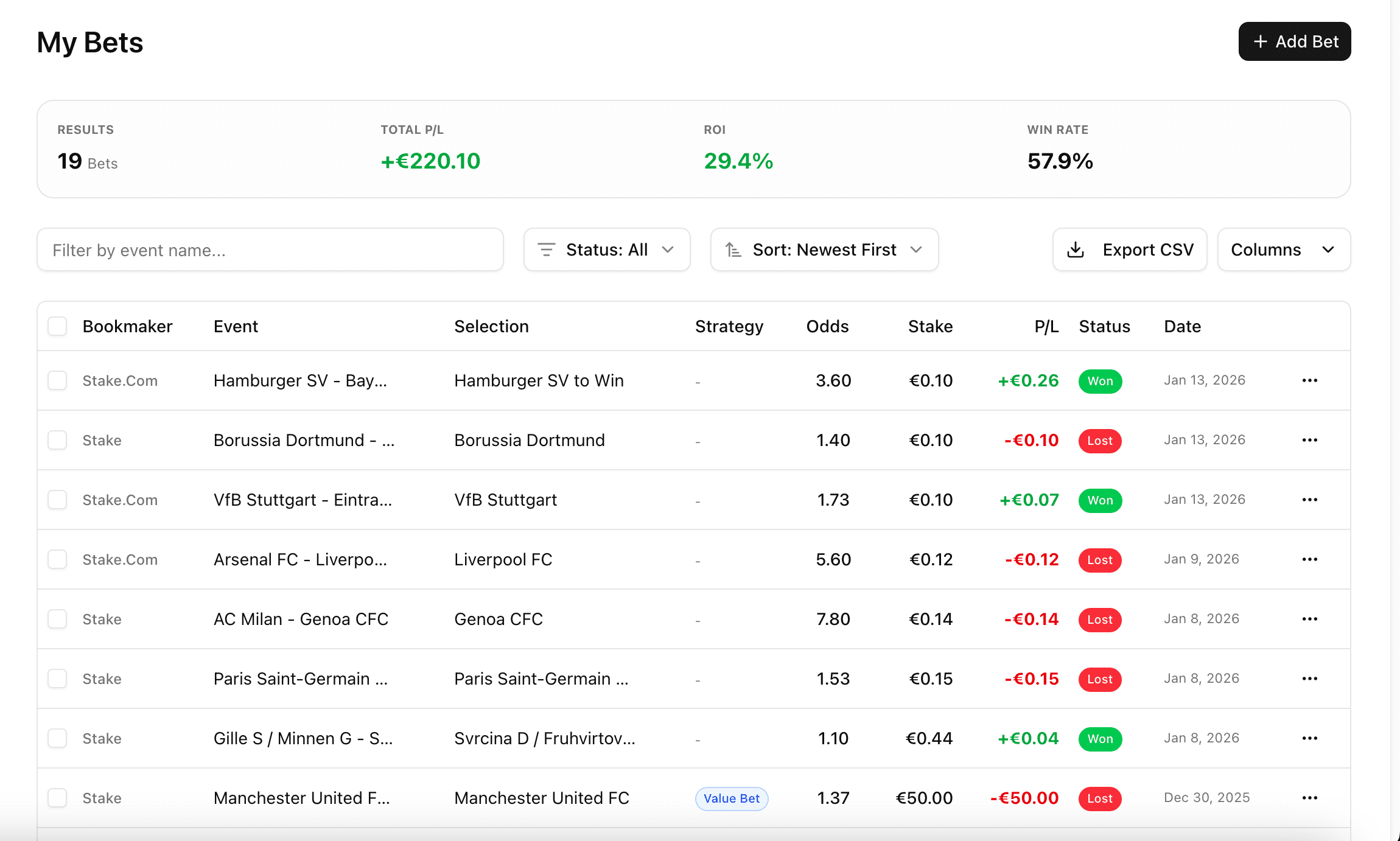
Purpose-built software like mybets.gg that automate data entry, calculate metrics automatically, and provide advanced analytics. These save time and reduce errors.
3. Hybrid Approaches
Some bettors use apps for tracking and spreadsheets for custom analysis, combining the best of both worlds.
Essential Components of Any Bet Tracker
Regardless of the system you choose, it must capture:
Bet details: Sport, league, teams, bet type, odds
Stake information: Amount wagered, units used
Timing data: When bet was placed, game date/time
Outcome data: Win/loss/push, profit/loss amount
Line information: Opening line, closing line, your price
Notes: Reasoning, confidence level, situational factors
15 Essential Metrics Every Bet Tracker Should Monitor
Profitability Metrics
1. Win Rate (Win Percentage)
The percentage of bets you win. Calculated as: (Wins / Total Bets) × 100
Important, but misleading in isolation
A 55% win rate at -110 odds is profitable; at -150, it's not
Track separately for different bet types and sports
2. Return on Investment (ROI)
Your percentage return relative to amount wagered: (Net Profit / Total Amount Wagered) × 100
The gold standard metric for betting performance
Accounts for both win rate and odds
Professional bettors typically target 3-7% ROI
3. Net Profit/Loss
Your bottom line in dollars. Simple but essential.
Track by sport, bet type, time period
Shows actual financial impact
Essential for bankroll management
4. Units Won/Lost
Profit expressed in betting units rather than dollars.
Normalizes performance across different bankroll sizes
Allows comparison with other bettors
Essential for discussing results publicly
Performance Analysis Metrics
5. Closing Line Value (CLV)
Whether you beat the closing line. Calculated by comparing your odds to the final odds.
The best predictor of long-term success
Consistent positive CLV indicates you're beating the market
Professional bettors average 2-4% CLV
6. Expected Value (EV)
The theoretical value of your bets based on your estimated win probability vs. implied odds probability.
Positive EV bets are profitable long-term
Helps identify which bets to make and which to avoid
Requires accurate probability estimation
7. Average Odds
The average price you're betting at.
Lower average odds often indicate value betting
Track separately for wins and losses
Compare to market averages
8. Average Stake Size
How much you're typically betting.
Should align with your unit size strategy
Identifies stake sizing inconsistencies
Reveals emotional betting patterns
Trend Analysis Metrics
9. Sport-by-Sport Performance
Breakdown of results by sport.
Identifies your strongest and weakest sports
Guides where to focus your efforts
Reveals sports to potentially avoid
10. Bet Type Performance
Results broken down by bet category.
Moneylines, spreads, totals, props, parlays, etc.
Shows where your edge truly exists
Prevents overconfidence in weak areas
11. Time-Based Analysis
Performance by day of week, month, or season phase.
Identifies scheduling patterns
Shows if you improve or decline over time
Reveals seasonal strengths
12. Streak Analysis
Tracking winning and losing streaks.
Helps manage emotional responses
Shows variance in action
Identifies when to adjust stakes
Advanced Metrics
13. Sharpe Ratio
Measures risk-adjusted returns: (Average Return - Risk-Free Rate) / Standard Deviation
Higher is better
Accounts for volatility in results
Compares performance relative to risk taken
14. Maximum Drawdown
The largest peak-to-trough decline in your bankroll.
Shows worst-case scenarios
Tests your psychological resilience
Guides appropriate bankroll sizing
15. Bet Frequency & Volume
Number of bets placed over time.
Identifies over-betting or under-betting
Shows discipline in selection
Impacts overall profitability
How to Set Up Your Sports Bet Tracking System
Step 1: Choose Your Tracking Method
For Beginners: Start with a dedicated bet tracking app like mybets.gg. The automation and built-in analytics will accelerate your learning curve.
For Excel Experts: If you're comfortable with spreadsheets and want complete customization, a well-designed Excel template can work.
For Serious Bettors: Use a dedicated app for daily tracking and export data periodically for custom analysis.
Step 2: Define Your Tracking Categories
Create consistent categories for:
Sports: NBA, NFL, MLB, NHL, Soccer, etc.
Leagues: Specific conferences, divisions, competitions
Bet Types: Spread, moneyline, total, prop, parlay, teaser
Confidence Levels: If you rate your picks (1-5 stars, etc.)
Sources: Your own analysis, touts, Discord groups, etc.
Step 3: Establish Data Entry Habits
The Golden Rule: Enter bets before the game starts, not after.
Why? Post-game entry leads to:
Selective memory (forgetting losing bets)
Odds manipulation (entering better lines than you actually got)
Incomplete records
Best Practice: Set a rule to log every bet within 15 minutes of placing it. Make it part of your betting routine.
Step 4: Schedule Regular Review Sessions
Tracking without analysis is just data collection. Schedule weekly and monthly reviews to:
Weekly: Check recent performance, identify any red flags
Monthly: Deep dive into sport/bet type breakdowns
Quarterly: Evaluate overall strategy and make adjustments
Annually: Comprehensive performance review and goal setting
The Problem with Manual Spreadsheets
Spreadsheets seem like the perfect solution—free, customizable, and familiar. But they have serious limitations for serious bettors.
Time Consumption
Manually entering each bet takes 2-3 minutes. If you place 50 bets per week, that's 2-3 hours of data entry monthly. A dedicated app reduces this to minutes.
Calculation Errors
Even experienced Excel users make formula mistakes. One incorrect cell reference can corrupt your entire analysis. Apps calculate everything automatically, eliminating human error.
Limited Analytics
Creating advanced charts and reports in Excel requires significant expertise. Apps provide professional-grade analytics out of the box:
Interactive graphs
Trend analysis
CLV calculations
Performance comparisons
Data Integrity Issues
Spreadsheets are prone to:
Accidental deletions
Formula overwrites
Version control problems
Device synchronization issues
No Real-Time Insights
With spreadsheets, you analyze historical data. With apps, you get real-time dashboards showing your current position, open bets, and live performance.
How to Analyze Your Tracking Data
The Monthly Performance Review
Once per month, conduct a comprehensive analysis:
1. Check Your Overall Numbers
Total profit/loss
ROI percentage
Win rate
Units won/lost
2. Sport-by-Sport Breakdown
Which sports are making you money? Which are costing you?
3. Bet Type Analysis
Are you better at spreads or totals? Props or parlays?
4. Closing Line Value Check
Are you consistently beating the closing line? If not, why?
5. Stake Size Review
Are you betting consistent units? Any emotional stake increases?
Identifying Patterns and Trends
Look for these patterns in your data:
Positive Patterns to Reinforce:
Consistent CLV in specific sports
Strong performance on certain bet types
Profitable trends on specific days or times
Success with specific confidence levels
Negative Patterns to Address:
Declining performance in previously strong areas
Increasing stakes during losing streaks
Poor results on specific bet types
Emotional betting after losses
Making Data-Driven Adjustments
Use your analysis to make strategic changes:
Double down on strengths: Increase volume in profitable areas
Eliminate weaknesses: Stop betting sports or bet types where you consistently lose
Adjust stake sizing: If CLV is strong, consider increasing unit size
Improve timing: If you're missing closing line value, bet earlier or later
Real-World Case Studies: Tracking Transformations
Case Study 1: From Break-Even to Profitable
Bettor: Sarah, NBA specialist Starting Point: Breaking even after two years of betting Tracking Revelation: Her data showed she was profitable on player props (+8% ROI) but losing on game totals (-12% ROI) Adjustment: Stopped betting totals, focused exclusively on props Result: +6.5% ROI over the following season
Case Study 2: The Chasing Problem
Bettor: David, multi-sport bettor Starting Point: Consistently losing bankroll Tracking Revelation: His stake sizes increased 300% after losing days Adjustment: Implemented strict unit sizing rules and tracking alerts Result: Reduced variance, extended bankroll life by 4x
Case Study 3: Finding the Hidden Edge
Bettor: Lisa, college sports fan Starting Point: Casual bettor, inconsistent results Tracking Revelation: 15% ROI on small conference games, -5% on major conferences Adjustment: Specialized in mid-major and small conference betting Result: Became a profitable bettor with a clear niche
Common Bet Tracking Mistakes to Avoid
Mistake 1: Inconsistent Data Entry
The Problem: Entering some bets but not others, or logging at irregular intervals
The Impact: Incomplete data leads to inaccurate analysis
The Solution: Log every single bet immediately after placing it
Mistake 2: Tracking Only Wins
The Problem: Only recording winning bets or "forgetting" to log losses
The Impact: Completely distorts your actual performance
The Solution: Be honest with yourself—track everything
Mistake 3: Ignoring Closing Line Value
The Problem: Focusing only on wins/losses without tracking CLV
The Impact: Miss the best predictor of long-term success
The Solution: Always record both your odds and closing odds
Mistake 4: Not Tracking Reasoning
The Problem: Recording bets without noting why you made them
The Impact: Can't identify which analysis methods work
The Solution: Add a notes field for each bet's rationale
Mistake 5: Analysis Paralysis
The Problem: Tracking so many metrics that you can't see the forest for the trees
The Impact: Overwhelmed by data, no actionable insights
The Solution: Focus on 5-7 key metrics that matter most
Advanced Bet Tracking Strategies
Tracking Your Betting Models
If you use models or systems, track their performance separately:
Model name/version
Confidence score
Predicted probability
Actual outcome
Model-specific ROI
This helps you refine and improve your models over time.
Line Shopping Tracking
Record which sportsbooks you're using and at what prices:
Compare odds across books
Track which books consistently offer better lines
Calculate the impact of line shopping on your bottom line
Research shows that line shopping can improve ROI by 1-3%—significant over time.
Situational Tracking
Add context fields to your tracking:
Rest advantages: Back-to-back games, extended rest
Travel situations: Long road trips, time zone changes
Weather conditions: Wind, temperature, precipitation
Injury situations: Key players in/out
Over time, you'll identify situational edges others miss.
The Psychology of Bet Tracking
Tracking Creates Accountability
When you know every bet is being recorded, you're less likely to:
Make impulsive wagers
Bet outside your bankroll
Ignore your own rules
Fall victim to tilt
Tracking Reduces Emotional Decision-Making
Data provides objective feedback that counters emotional reactions:
After a bad beat, data shows it's just variance
During a hot streak, data keeps you grounded
When considering a bet, historical data informs the decision
Tracking Builds Confidence
When you have proof of your edge, you:
Trust your process during downswings
Make decisions based on evidence, not fear
Maintain discipline when it matters most
Building Your Bet Tracking Routine
Daily Habits
Morning (5 minutes):
Review overnight results
Update tracking with outcomes
Check open positions
Pre-Betting (2 minutes per bet):
Log bet immediately after placing
Record all required fields
Add brief notes on reasoning
Evening (5 minutes):
Review day's activity
Note any patterns or observations
Prepare for next day
Weekly Review (30 minutes)
Every Sunday, conduct a weekly review:
Calculate week's profit/loss
Review sport-by-sport breakdown
Check CLV for the week
Identify any concerning patterns
Plan adjustments for next week
Monthly Deep Dive (1-2 hours)
First of each month, conduct comprehensive analysis:
Full performance review
Sport and bet type analysis
Trend identification
Strategy adjustment planning
Goal progress assessment
Tools and Resources for Bet Tracking
Recommended Bet Tracking Apps
mybets.gg (Recommended)
Automated data entry
Advanced analytics dashboard
CLV tracking
Sport/bet type breakdowns
Mobile-friendly interface
Spreadsheet Templates
If you prefer spreadsheets, look for templates that include:
Pre-built formulas for ROI, win rate, etc.
Sport and bet type categorization
Graphs and charts
CLV calculation fields
Complementary Tools
Odds Comparison Sites:
OddsJam
Unabated
Sportsbook Review
Line Movement Trackers:
Action Network
BetQL
Vegas Insider
Statistical Resources:
Sports Reference sites
TeamRankings
Killer Sports
Conclusion: Start Tracking Today
If you take one thing from this guide, let it be this: you cannot improve what you don't measure.
Sports bet tracking isn't just for professionals—it's for anyone who wants to approach betting seriously and maximize their chances of long-term success. The insights you'll gain from proper tracking will transform your betting from guesswork into a data-driven endeavor.
The best time to start tracking was when you placed your first bet. The second-best time is today.
Whether you choose a sophisticated app like mybets.gg or build your own spreadsheet system, the important thing is to start. Begin with the basics, be consistent with your data entry, and commit to regular analysis.
Your future profitable self will thank you.
Ready to Transform Your Betting?
Stop guessing and start tracking. mybets.gg makes sports bet tracking simple, automated, and insightful. With real-time analytics, CLV tracking, and comprehensive reporting, you'll have everything you need to bet smarter.
[Start Your Free Bet Tracking Journey with mybets.gg →]
Written by the Mybets.gg Team
Our team of sports betting analysts, data scientists, and professional bettors working together to bring you the most accurate strategies and insights. We combine data-driven analysis with real-world experience.
Related Articles
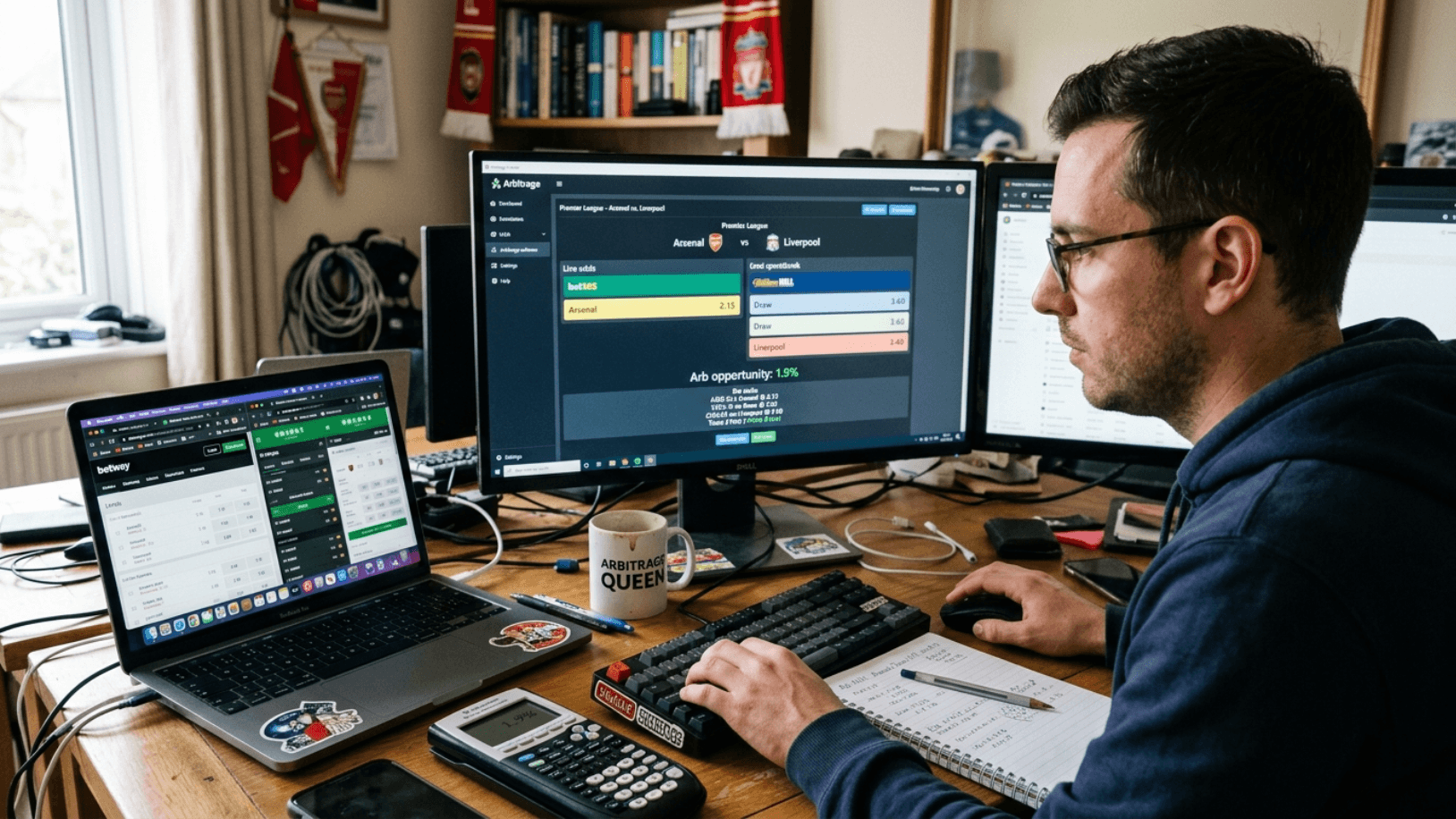
Is Arbitrage Betting Still Profitable in 2026? (The Brutal Truth)
The golden era of lazy sports betting arbitrage is over. Discover the math behind profitable arbing in 2026, how to avoid getting limited by sportsbooks, and why automated AI tracking is now mandatory to beat the closing line.

Excel vs. Bet Tracking Apps: Which is Better for Serious Bettors?

Best Sportsbook Tracking Apps with Bankroll Management Features (2026 Guide)
99% of bettors lose because they don't know their numbers. In this guide, we compare the top betting trackers on the market—from manual spreadsheets to "The Action Network"—and reveal why AI-powered tracking is the future of profitable betting.