Sports Arbitrage Betting: How to Find Risk-Free Profits (And Why Most Bettors Fail)
Sports arbitrage betting promises guaranteed profits by exploiting odds differences across sportsbooks. But here's the reality: what works in theory often fails in practice. The opportunities disappea...
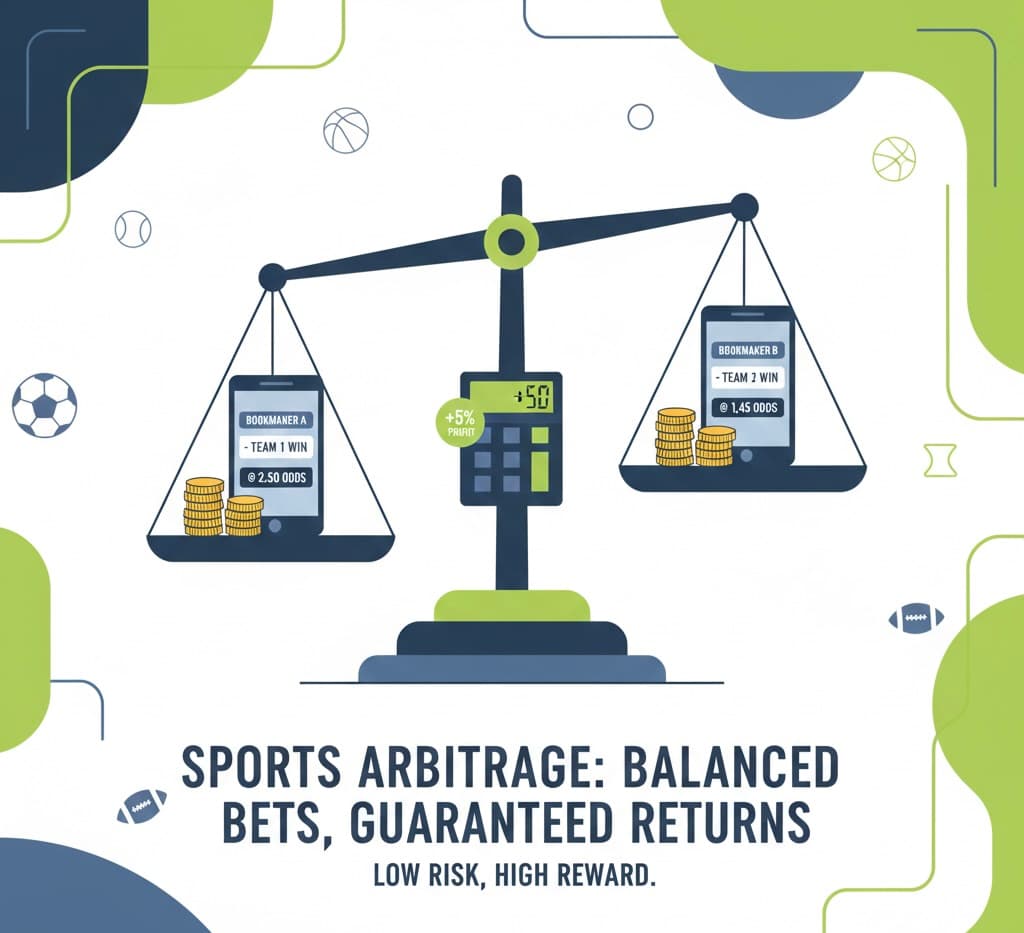
Sports arbitrage betting promises guaranteed profits by exploiting odds differences across sportsbooks. But here's the reality: what works in theory often fails in practice. The opportunities disappear in seconds, sportsbooks actively limit winning accounts, and hidden costs erode your already-thin margins. This guide breaks down how arbitrage betting actually works, why it's harder than it looks, and whether it's worth your time in 2026.
What Is Sports Arbitrage Betting?
The Basic Concept
Arbitrage betting—also called "arbing" or "sure betting"—involves placing bets on all possible outcomes of an event across different sportsbooks to guarantee profit regardless of the result. It exploits odds discrepancies between bookmakers who price the same event differently.
Unlike regular betting where you risk losing your stake, arbitrage betting locks in a small profit through mathematical certainty. When Sportsbook A offers odds that are significantly higher than Sportsbook B's odds on the opposite outcome, you can bet both sides and profit from the gap.
Real-World Example
Consider a tennis match between Player A and Player B:
Sportsbook A offers Player A at +150 (2.50 decimal odds)
Sportsbook B offers Player B at +180 (2.80 decimal odds)
By calculating the proper stake distribution, you can bet $357 on Player A and $321 on Player B (total investment: $678). If Player A wins, you collect $892.50 from Sportsbook A. If Player B wins, you collect $898.80 from Sportsbook B. Either way, you profit roughly $215-220, or about 2-3% of your total investment.
This guaranteed return is what makes arbitrage appealing—but as you'll see, the reality is far more complex than this simple example suggests.
How Does Arbitrage Betting Work? (Step-by-Step)
1. Find Odds Discrepancies
The first step is monitoring multiple sportsbooks for the same event with differing odds. This requires either manually checking 5-10 different sites or using specialized arbitrage finder software that scans hundreds of bookmakers simultaneously.
According to Investopedia, "arbitrage opportunities are eliminated in a matter of seconds due to computerized trading systems"—and the same principle applies to sports betting markets. Professional odds traders and automated systems quickly identify and exploit pricing inefficiencies, closing the window for profit.
2. Calculate Arbitrage Percentage
Once you've found differing odds, you need to determine if a true arbitrage opportunity exists. Use this formula to calculate the total implied probability:
Arbitrage Formula:
(1/Decimal Odds 1) + (1/Decimal Odds 2) < 1 = Arbitrage exists
If the sum is less than 1 (or less than 100% when expressed as a percentage), you have an arbitrage opportunity. The further below 1, the larger your profit margin.
3. Determine Stake Distribution
Next, calculate exactly how much to bet on each outcome to guarantee equal profit. The formula is:
Stake Formula:
Individual Stake = (Total Investment × Individual Implied Probability) / Decimal Odds
Getting this calculation wrong eliminates your profit margin entirely, which is why most successful arbers use calculators rather than manual math.
4. Place Bets Simultaneously
Timing is critical. You need to place all bets quickly before odds change. According to Investopedia's analysis of forex arbitrage, "price discrepancies that once lasted several seconds or minutes now remain for only sub-second timeframes" due to algorithmic trading. Sports betting faces the same compression of opportunity windows.
Most profitable arbitrage opportunities offer 1-3% margins, not the 10%+ that beginners expect. By the time you manually calculate stakes and navigate to both sportsbooks, the odds have often already moved.
Sports Arbitrage Betting Calculator: How to Calculate Your Stakes
Manual Calculation Method
Let's walk through a manual calculation using our tennis example:
Convert American odds to decimal: +150 = 2.50, +180 = 2.80
Calculate implied probabilities: 1/2.50 = 0.40 (40%), 1/2.80 = 0.357 (35.7%)
Add probabilities: 0.40 + 0.357 = 0.757 (75.7%)
Confirm arbitrage exists: 75.7% < 100% ✓
Calculate profit margin: 100% - 75.7% = 24.3%
Determine stakes: For $1,000 total investment:
Player A: ($1,000 × 0.40) = $400
Player B: ($1,000 × 0.357) = $357
This manual process takes 2-3 minutes—an eternity in arbitrage betting where opportunities vanish in seconds.
Using the mybets.gg Arbitrage Calculator
The Mybets.gg Arbitrage Calculator solves the speed problem. Simply input the odds from each sportsbook and your total stake amount. The calculator instantly provides:
Exact stake distribution for each outcome
Expected profit in dollars
Profit percentage
Confirmation whether an arbitrage opportunity exists
The calculator helps avoid costly mathematical errors that can eliminate your profit margin entirely. When you're trying to place bets within a 30-second window, instant results make the difference between capturing the opportunity and missing it.
Why Sports Arbitrage Betting Usually Fails (The Reality Check)
The Speed Problem
Most arbitrage guides present arbing as "risk-free money," but reality is far more complex. Professional arbitrage bettors use automated software that identifies opportunities and places bets in milliseconds. Manual bettors simply can't compete on speed.
As Investopedia notes, "market makers need access to dealing desks, faster computers, and more capital to exploit pure arbitrage opportunities before retail traders." The same dynamic exists in sports betting—professional syndicates have technological advantages that retail bettors can't match.
Account Limitations
Sportsbooks actively identify and limit arbitrage bettors. They track betting patterns, stake sizes, and timing. When they detect advantage play, they implement "gubbing"—account restrictions that prevent you from placing full stakes or accessing certain markets.
You might successfully arb for a few weeks, but eventually most sportsbooks will limit your account to $50 maximum bets, making profitable arbitrage impossible. Some books ban arbers outright.
Hidden Costs That Kill Margins
A 2% profit margin sounds safe until you factor in the hidden costs:
Withdrawal fees: $5-10 per withdrawal across multiple sportsbooks
Currency conversion: 1-3% on international books
Bet cancellations: One side voided leaves you exposed on the other
Odds changes: Second bet placed at worse odds than calculated
The math is brutal: A 2% profit margin disappears entirely with just a 1% withdrawal fee at each sportsbook. Factor in the time investment—10-20 hours weekly to find and execute opportunities—and many arbers earn less than minimum wage.
Types of Arbitrage Betting Opportunities
Pre-Match Arbitrage
Traditional arbitrage on odds before an event starts is the most common approach. You're comparing static lines across sportsbooks, looking for pricing inefficiencies. Profit margins typically range from 1-2%, and opportunities are easiest to find but also most competitive.
Live Betting Arbitrage
Exploiting rapid odds changes during games offers higher margins—sometimes 3-5%—but requires the fastest execution. Live odds fluctuate based on game flow, creating brief windows where different sportsbooks haven't synced their prices. You need to watch games in real-time and place bets within seconds.
Bonus Arbitrage
Using welcome bonuses and free bets to create arbitrage situations is more accessible for beginners. According to The Action Network, "bonus bets on +900 underdogs yield 90% EV ($90 per $100 bet) vs only 10% EV on -900 favorites."
By strategically placing your bonus bet on a high-odds underdog and hedging with real money on the favorite at another sportsbook, you can guarantee profit. The downside? It's a one-time opportunity per sportsbook, not a sustainable long-term strategy.
The best sports for arbitrage are tennis (only two outcomes), soccer, and basketball (many markets available). These sports offer the most frequent opportunities and clearest two-way betting options.
Arbitrage vs. Positive Expected Value (+EV) Betting
Strategy | Profit Type | Typical Margin | Account Requirements | Sustainability | Skill Level |
|---|---|---|---|---|---|
Arbitrage | Guaranteed | 1-3% | 5-7 sportsbooks | Low (account limits) | Moderate |
+EV Betting | Probabilistic | 5-10%+ | Single account | High | Advanced |
Arbitrage betting guarantees profit mathematically but faces practical limitations like account restrictions and thin margins. Positive Expected Value (+EV) betting offers probabilistic profit with higher margins but includes variance in results.
The key difference: +EV betting may be more sustainable long-term because it generates less scrutiny from sportsbooks. You're not betting every side of every game—you're selectively finding value, which looks more like regular betting behavior.
Both strategies require disciplined bankroll management, but +EV betting works with a single account while arbitrage demands maintaining relationships with 5-7+ sportsbooks simultaneously.
Finding Arbitrage Betting Opportunities
Arbitrage Bet Finder Tools
Specialized software that scans hundreds of sportsbooks is essential for serious arbers. Services like OddsJam, RebelBetting, and BetBurger cost $50-200 monthly but find opportunities you'd never spot manually. These tools monitor odds changes in real-time and alert you the moment an arbitrage situation appears.
Without these tools, you're competing against professionals who have them. It's like bringing a calculator to a computer programming competition.
Manual Scouting Method
The manual approach involves comparing odds across 5-10 sportsbooks for the same event. Open multiple tabs, check lines, calculate margins, repeat. It's time-intensive and finds far fewer opportunities—maybe 1-2 per week versus 10-20 daily with paid tools.
Manual scouting only makes sense if you're testing arbitrage betting before committing to paid software. For sustainable arbing, the software investment is non-negotiable.
Best Markets for Arbitrage
Lower-profile events offer the best opportunities because odds corrections happen more slowly. Think tennis challenger tournaments, smaller soccer leagues, or mid-tier MMA fights. Major events like NFL games or Champions League matches have odds that sync almost instantly across books.
According to Covers, "28% of all MLB baseball games are decided by only one run," making baseball's frequent two-way markets (moneylines, run lines) suitable for arbitrage opportunities. The sport's daily volume creates more chances for pricing discrepancies.
Geographic advantages matter too. Different time zones mean different peak betting times and odds discrepancies. European bettors might find value on American sports overnight when fewer traders are active.
Reality check: Free manual methods find 1-2 opportunities weekly. Paid tools find 10-20 daily, but you're competing against thousands of other subscribers for the same opportunities.
Requirements for Successful Arbitrage Betting
Here's what you actually need to make arbitrage betting work:
Multiple sportsbook accounts (minimum 5-7): More accounts mean more opportunities. You need accounts funded and verified at numerous books to execute both sides of arbitrage bets.
Sufficient bankroll ($2,000-5,000 minimum): Your capital needs to be split across multiple sportsbooks. With smaller bankrolls, the absolute dollar profits don't justify the time investment.
Fast internet connection and device access: Seconds matter. Slow internet or clunky mobile betting apps mean missed opportunities.
Arbitrage calculator or finder software: Manual calculation is too slow. You need tools that instantly show stake distribution and profit margins.
Time commitment (10-20 hours weekly): Finding opportunities, placing bets, managing accounts, tracking results—it's a part-time job, not passive income.
Disciplined record-keeping: With bets across multiple platforms, tracking becomes complex. You need to know exactly where your money is and which bets are pending.
Tools like Mybets.gg help with requirement #6 by automatically tracking bets across all your sportsbooks via Chrome extension, eliminating manual spreadsheet work.
Let's calculate realistic returns: $5,000 bankroll × 2% average margin × 20 opportunities monthly = $2,000 monthly profit. But subtract software costs ($100), withdrawal fees ($50-100), and account for the 30% of opportunities where odds move before you complete both bets. Real profit: $1,200-1,500 monthly before taxes, requiring 15-20 hours of work weekly. That's $15-25 per hour—decent, but not the "easy money" many guides promise.
Is Sports Arbitrage Betting Legal?
Yes, arbitrage betting is legal in jurisdictions where sports betting is legal. It's not illegal, but sportsbooks don't like it and will limit or ban your account under their terms of service.
There's an important distinction between legality and sportsbook policies. Arbitrage isn't criminal—you won't face legal consequences. However, sportsbooks typically prohibit "advantage play" in their terms of service, giving them the right to restrict your account.
You face no legal risk as a bettor, only the business risk of account closure. Some jurisdictions like the UK have stronger bettor protections against arbitrary account closures, but most regions allow sportsbooks wide discretion in limiting players.
The advice: Avoid obvious patterns like betting only +EV sides, using round stake amounts ($500, $1,000), or placing bets seconds after odds post. Blend in with regular betting behavior to extend your account lifespan.
Arbitrage Betting Strategy: Tips for Avoiding Detection
While these tactics can't prevent eventual detection, they help delay it:
Vary bet sizes: Don't always bet maximum or use round numbers. Mix in $237, $418, $563 instead of $250, $500, $600.
Place occasional non-arbitrage bets: Throw in some regular bets to appear like a typical bettor. Take a -110 spread bet that's not part of an arb.
Don't withdraw immediately: Leaving money in your account after profitable arbs looks more natural than withdrawing after every win.
Use different betting patterns: Don't always bet the favorite at Book A and underdog at Book B. Randomize which book gets which side.
Avoid betting only closing lines: Betting exclusively at the best available odds is a red flag. Sometimes accept slightly worse odds to blend in.
Spread activity across days: Rapid-fire betting on 10 games in one hour screams arbitrage. Space bets throughout the week.
Accept lower odds sometimes: Not every bet needs maximum value. Occasionally taking -115 instead of -110 helps avoid pattern detection.
Reality: These tactics delay but don't prevent eventual detection at most sportsbooks. Professional risk management teams use sophisticated algorithms to identify advantage players. Your account lifespan might extend from 2 months to 6 months, but limits eventually come.
Should You Try Arbitrage Betting in 2026?
When Arbitrage Makes Sense
Arbitrage betting makes sense if you have:
$5,000+ bankroll you can split across multiple books
15+ hours weekly to dedicate to finding and executing opportunities
Access to arbitrage software ($50-200/month budget)
Live in a jurisdiction with many legal sportsbooks (10+ options)
Realistic expectations about hourly earnings ($15-30/hour)
Better Alternatives for Most Bettors
Arbitrage doesn't make sense if you have limited bankroll, limited time, only 2-3 sportsbook options, or you're seeking passive income. Consider these alternatives:
Alternative 1: +EV betting with single sportsbook. Find value bets where your estimated probability exceeds the implied probability of the odds. More sustainable because you're not flagged as an arber, though it requires sharp handicapping skills.
Alternative 2: Matched betting with bonuses. Systematically convert signup bonuses and promotions into guaranteed profit. It's one-time profit per book but simpler to execute than ongoing arbitrage.
Alternative 3: Sharp betting with line shopping. Develop handicapping skills and always bet the best available line across your sportsbooks. Requires analytical ability but avoids the detection issues of pure arbitrage.
Honest assessment: Arbitrage is a "job" not passive income—treat it as such. Expected realistic hourly rate after the learning curve: $15-30/hour for manual arbing. Professional arbers use teams and automated software—that's a different game entirely than retail bettors playing manually.
Tracking Your Arbitrage Bets with mybets.gg
The challenge with arbitrage is tracking multiple bets across multiple sportsbooks simultaneously. You need to know which bets are pending, which have settled, and whether your arbitrage opportunities actually resulted in profit after fees and limitations.
Manual tracking in spreadsheets is error-prone and time-consuming. When you're placing 50-100+ bets weekly across 7 different sportsbooks, the organizational overhead becomes overwhelming.
The mybets.gg Chrome extension automatically captures bet details from screenshots, eliminating manual data entry. The dashboard shows all your bets across sportsbooks in one place, making it easy to:
Track which arbitrage opportunities actually resulted in profit after all costs
Identify which sportsbooks have the best execution speed and fewest cancellations
Calculate true ROI including all hidden costs like withdrawal fees
Free up time spent on manual tracking to find more opportunities
For serious arbers managing dozens of bets weekly, automated tracking is essential. It's the difference between spending 2 hours on spreadsheets or 2 hours finding more profitable opportunities.
Key Takeaways
Sports arbitrage betting guarantees profit mathematically but faces practical challenges: opportunities disappear in seconds, sportsbooks limit winning accounts, and hidden costs erode thin margins of 1-3%.
Successful arbitrage requires significant bankroll ($2,000-5,000+), multiple sportsbook accounts (5-7 minimum), specialized software, and 10-20 hours weekly time commitment—it's a part-time job, not passive income.
Manual arbitrage betting typically yields $15-30/hour after the learning curve. Most profitable opportunities are found by automated software, not manual scouting.
Use the mybets.gg Arbitrage Calculator to instantly calculate stake distribution and avoid costly mathematical errors that eliminate profit margins.
For most bettors, +EV betting or matched betting offers better risk-reward than pure arbitrage due to lower detection risk and account sustainability.
Conclusion
Sports arbitrage betting works in theory and can generate consistent profits—but it's far more challenging than most guides suggest. The combination of disappearing opportunities, account limitations, and hidden costs means only dedicated bettors with proper tools and bankroll will succeed.
Before diving in, honestly assess whether you have the time, capital, and technical setup required. Can you commit 15+ hours weekly? Do you have $5,000+ to split across multiple sportsbooks? Are you prepared for the inevitable account limits?
For casual bettors, exploring +EV betting or focusing on developing sharp betting skills may offer better long-term results. If you do pursue arbitrage, use tools like the mybets.gg Arbitrage Calculator and bet tracking dashboard to maximize efficiency and avoid costly mistakes.
The math works. The question is whether you can execute fast enough, manage enough accounts, and sustain the effort long enough to make it worthwhile. For most bettors in 2026, the answer is probably no—but for those with the right setup and realistic expectations, arbitrage can provide steady supplemental income.
Written by the Mybets.gg Team
Our team of sports betting analysts, data scientists, and professional bettors working together to bring you the most accurate strategies and insights. We combine data-driven analysis with real-world experience.